
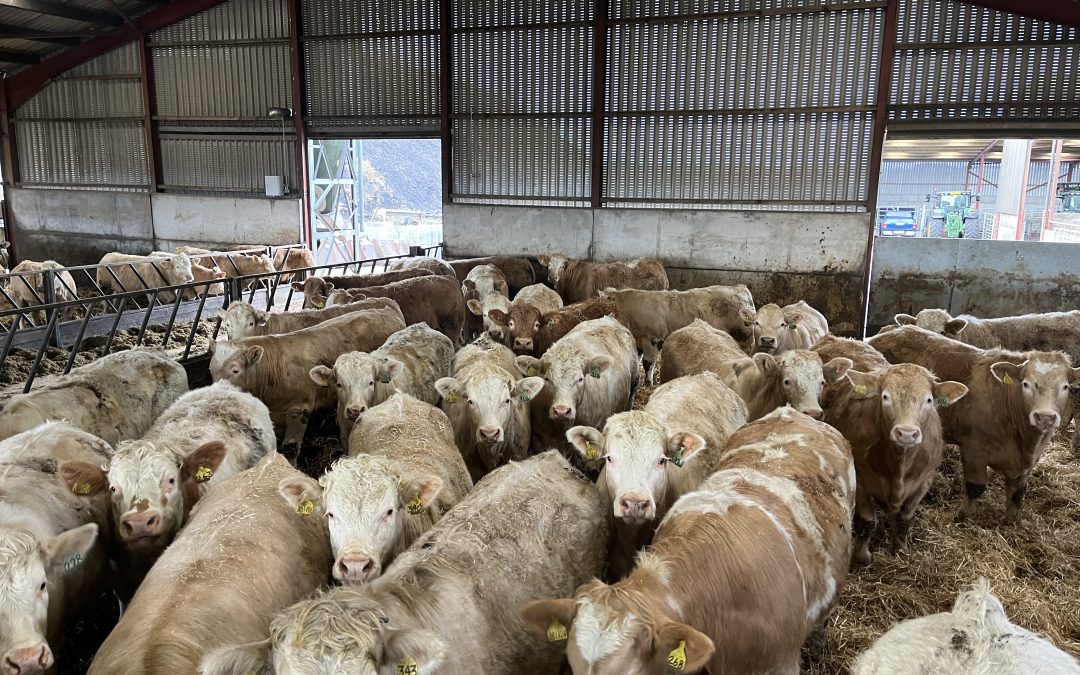
Winter feeding is one of the biggest costs on a beef farm, so getting more value from every tonne of forage and every kilogram of concentrate is essential. A well-formulated Total Mixed Ration (TMR) can be an effective way of achieving this, but the starting point is always the same: know the quality of the forage available, identify what is missing, and build the ration around the requirements of the cattle.
Start with the forage
Once silage has been made it should be allowed to ferment for at least six weeks before being sampled. A representative sample can then be analysed to establish key measures including dry matter, crude protein, metabolisable energy, fibre levels and fermentation quality.
Knowing the quality of the forage is the foundation of an efficient winter feeding programme. It allows the ration to be formulated accurately and prevents concentrate from being overfed where it is not needed, while ensuring sufficient supplementation is provided to help cattle achieve the target daily liveweight gain (DLWG).
Build the TMR around the forage
A TMR is only as good as the ration going into the mixer. Forage, concentrates, minerals and other ingredients need to be formulated together to provide the correct balance of nutrients for the cattle being fed.
The ration should be built around the quality of the silage, the cattle’s liveweight and production stage, and the target daily liveweight gain.
A bespoke meal can be designed to complement the forage rather than simply adding a standard feed. Protein level, energy sources, fibre and mineral supply, as well as the raw materials used can all be adjusted to address the specific shortfalls identified in the forage.
One of the key benefits of a well-mixed TMR is consistency. Cattle receive the same balance of nutrients in every mouthful, reducing the opportunity for selective feeding and helping to keep them settled and more content. With feed available throughout the day and less variation in what they consume, cattle can maintain a more consistent intake and performance.
Where home-grown barley is available, for example, it may be more cost-effective to use a higher-protein complementary meal alongside it. The farm’s own cereal can supply a significant proportion of the starch and energy, while the purchased feed provides additional protein, fibre, minerals and other nutrients required to balance the complete ration.
The same principle applies whether cattle are being fed through a TMR, home-grown cereals with a bespoke meal, or a compound feeding system: the feed should complement what is already available on farm.
Customer success
For Robert McCarlie and family, Wester Hassockrigg Farm, Shotts, a bespoke meal has been the feed of choice for their charolais-cross calves for more than 10 years.
Running a spring calving herd of 200 simmental-cross suckler cows, calves are weaned and housed from the middle of October. Prior to housing, pit silage is analysed and a Davidsons bespoke meal is formulated to complement the forage. Expected calf performance is also taken into consideration, with the aim of producing calves with a large skeletal frame to achieve maximum daily live weight gains.
Calves start on 3kg of Davidsons bespoke meal alongside 17kg silage per day, with the silage allowance adjusted according to dry matter. This increases to 4kg per head from January. Last year calves achieved an average daily liveweight in excess of 1.5kg.
The first 50 bullocks were sold in March at Lawrie & Symington, Lanark, between 10-12 months of age, averaging 511kg and selling for £2192 per head.
Robert says “A bespoke meal works well for us. The calves are content as their feed is consistent, they have feed in front of them throughout the day and aren’t waiting to hear the sound of a feed bag. The calves are achieving big weights quickly, which means we can get stores off farm quicker to free up shed space for the spring-calving cows”.
Look beyond the price per tonne
When selecting a feed, it is important to look beyond the price per tonne. A cheaper ration is not necessarily the most cost-effective option if it results in poorer feed utilisation or lower daily liveweight gain.
The specification and raw materials used can tell you a lot about the quality of a ration. Maize, barley, beet pulp and rape are good examples of raw materials that can provide valuable sources of energy, digestible fibre and quality protein when included appropriately.
It is also important to consider the balance of starch, energy, protein and fibre, including the supply of digestible undegradable protein (DUP) where appropriate for the target cattle.
For example, a ration costing £20 more per tonne may initially appear significantly more expensive. At a 4kg/day feeding rate, however, the difference works out at around 8p per head per day.
If the higher-quality ration delivers improved daily liveweight gain and better feed utilisation, that additional cost can quickly be justified through greater output.
The objective should therefore be to look at cost per kilogram of liveweight gain, rather than simply cost per tonne of feed.
Make every kilogram of feed count
Whether the farm is feeding a complete TMR, home-grown cereals with a bespoke meal, or a compound feeding system, matching nutrient supply to animal requirements can improve feed utilisation, support target daily liveweight gains, reduce waste and control the cost of production.
This winter, it’s not just about what the feed costs, It’s about how efficiently it turns into performance.
Recent Comments