
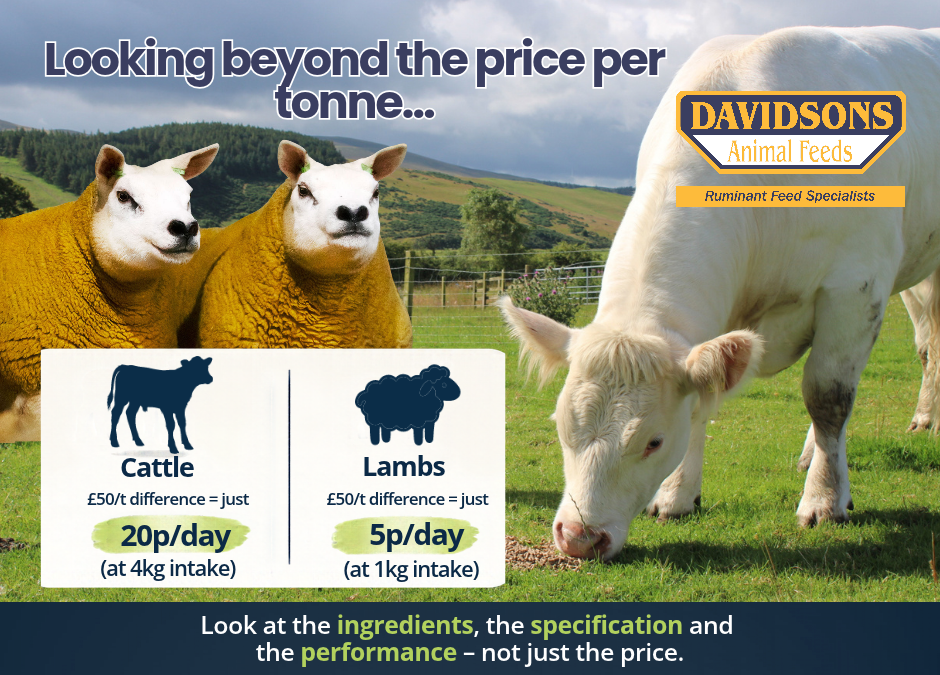
When selecting a feed, it is important to look beyond the price per tonne. A cheaper ration is not necessarily the most cost-effective option if it results in poorer feed utilisation, lower daily liveweight gain or more days being required to reach target weight.
The raw materials, nutritional specification and overall formulation can tell you a lot about the quality of a ration. Maize, barley, beet pulp and rape are good examples of ingredients that can provide valuable sources of energy, digestible fibre and quality protein when included appropriately. It is also important to consider the overall balance of energy, starch, protein and fibre, alongside the supply of digestible undegradable protein (DUP) where appropriate for the class of stock being fed.
Ultimately, the aim is not to buy the cheapest tonne of feed, but to produce kilograms of liveweight as efficiently and economically as possible.
CALVES – WHAT DOES £50/T REALLY COST?
Take a 400kg calf eating 4kg of feed per day.
A £50/t difference between two rations sounds significant, but it equates to just 5p/kg of feed – or 20p per calf per day at a 4kg intake.
If take cattle value of approximately £4.00/kg liveweight, the calf only needs to achieve an additional 0.05kg (just 50g) daily liveweight gain to cover that extra feed cost.
If a higher-quality formulation delivered an additional 0.25kg DLWG, that extra performance would be worth approximately £1.00/head/day.
Over 180 days:
- 45kg additional liveweight = £180/head.
- Additional feed cost = £36/head
- Potential additional return = £144/head
- Across 100 calves, that’s £14,400 in potential additional return after accounting for the difference in feed cost.
THE SAME PRINCIPLE APPLIES TO LAMBS
At an intake of around 1kg/head/day, a £50/t difference in feed price equates to just 5p per lamb per day.
If the higher-quality formulation delivered an additional 0.10 kg DLWG, and lambs were valued at approximately £3.40/kg liveweight, that additional performance would be worth 34p/head/day.
Over 60 days:
- 6kg additional liveweight = £20.40/head
- Additional feed cost = £3.00/head
- Potential additional return = £17.40/head
- Across 100 lambs, that’s £1,740 of potential additional return.

These examples demonstrate why feed should not be judged solely on £/tonne. Even a relatively small improvement in daily performance can quickly outweigh a difference in feed price. Look at the raw materials. Look at the specification. Look at the expected performance.
An energy-dense, well-formulated ration may look more expensive on a £/tonne basis, but the animal isn’t being paid to eat tonnes of feed – it’s being paid to produce kilograms of liveweight.
THE REAL QUESTION IS:
What does each kilogram of feed cost me – and what does it produce?
Recent Comments